Diehl Marcus & Company: LA’s Curious Goods

43425705_2213048028770603_9010776017605754880_n

DSCF6170

Like the fabled shop Curious Goods from a TV show on long ago, there is a new shop in LA that delivers the rarest of classic sartorial wears, historical curiosities, better umbrellas, safari accouterments, classic books, Victorian atmosphere and a game of chess oft paired with a historic cocktail at their ever growing parties; This latest one being an honorable tribute to Ricky Jay, a man that opened the eyes and changed the lives of perceptive individuals through my own lifespan and generations to come. – He is missed.

DSCF6161I am the kid that would pay to go to Disneyland at times just to hang out around the jungle cruise ride and the Temple of the Forbidden Eye just for the atmosphere of adventure and history rolled into one.

The shop I’m going to talk about. Diehl Marcus & Co. has truly captured that romance in feel… and you can buy the stuff on the walls!

If J. Peterman and 1980s Banana Republic had a store, this would be the flagship.

Christian Marcus and Erika Diehl-Marcus started something quite exquisite and unique in the LA community; an antique and curio shop that is often common in corners of London, is eluded to but at times disappointing when you see the price tags and lack of variety in squished versions of shops stumbled upon in Manhattan, yet ensconcing when laid out like the frame of an image from a history book in a city where history often catches fire right as the locals want to fight for the preservation of long forgotten icons; a refreshing anomaly in LA and something soon to become an icon in its own right. At DM & Co. in full view, are the rarest of rare items that you’ve seen in 1930s issues of national Geographic — I even picked up a vintage scarf from the famed brand J. Press on my last visit as it reminded me of something a professor from a bygone era would wear when he’s still representing his alma mater while watching a rowing competition.

I’m quite in love. DM & Co. Is finally and truly the place where I can dress like Sherlock Holmes while feeling perfectly in place. An establishment where one can have a sit down and talk with the proprietor and proprietress about Sir Arthur Conan Doyle or Herbert G. Wells, and invite well natured friends to discuss the happenings of the world and the oddities of it surrounding us.48051539_10156041908823811_1221968073167208448_n

Yesterday, I did just that at their latest event. The tribute party I mentioned in the intro to this article. A party featuring conjurers performing illusions that baffled me and excited many.

Unlike any other venue in this part of the world, the conjurers and the (inebriation from the cocktails) ours devours gave the entire scenario a surreal, yet in the real world quality of being part of a movie, the likes of the Illusionist or the Prestige. Guests classically togged in their evening finest, gathered in celebration and conversed over the life and exemplary merits of the Author and Magician Ricky Jay, a man particularly known for his prowess throwing playing cards with great accuracy; some would say “deadly” accuracy. 47579480_10156041908343811_8922523811291594752_n

Ricky Jay was the de facto standard when referencing what one thinks of the term ‘master at his craft’. A luminary a historian and a man that greatly embraced the past yet lived deeply in the present. With guest told of his history and the watermelon sliced as a target for cards, he was honored and missed dearly. I truly felt he would have appreciated the affair presented, and the appropriate venue inspired by and in some ways attributed to him. IMG_2844

Of the festivities, there were performances by Fredrick Falk which were spectacularly entertaining and confounding to me and Lauro Castillo that tried my sense of discipline as I watched his mastery of cardistry and slight of hand, but above all else was the talk from the proprietor himself of his relationship with Ricky Jay.

Christian in his youth had admired and studied Ricky. Read his books and even contacted the publishers in order to reproduce imagery that was only found within Ricky’s pages so he could make them into antiquarian posters to cocoon him in the beautiful world that the crafty imaginative books created.IMG_2893

I think what I loved most about the tribute was that it was from the heart and from a true admirer. In the end, Christian showcased his own impeccable talents in a neglected art in which he focused on in his youth, the art of plate spinning.48360691_10156041908873811_1592900415425347584_n

If you’re in LA, and you are one like me, hungry for adventure… or just hungry for hard to find Curious Goods. There are many antique shops, but this one… this one is the fabled one the adventurer walks into when they find that pair of goggles they took to India or discovered the novel about the Spanish Civil War.DSCF6136

And also, there aren’t many places I could imagine would do proper justice when it comes to a tribute to a man like Ricky Jay. It was done in the right way. And for that, I’m happy.IMG_2760

It’s not an antique shop. It’s not a novelty shop. It’s truly a fantasy and adventure stop, and in that… sometimes, a shop.

47686645_10156041908653811_1890646888621801472_n

48374630_10156041907623811_2100537499381137408_n

47682285_10156041908763811_8670608392944877568_n

48365292_10156041907488811_6635937644431802368_n

DIehl Marcus & Company

4707 Fountain Ave, Los Angeles, CA 90029


From Fashion to Fad (and back again): A Skim-med History of the Straw Boater Hat

cd09bd23214b80f9058fd6f266832c9d.jpg

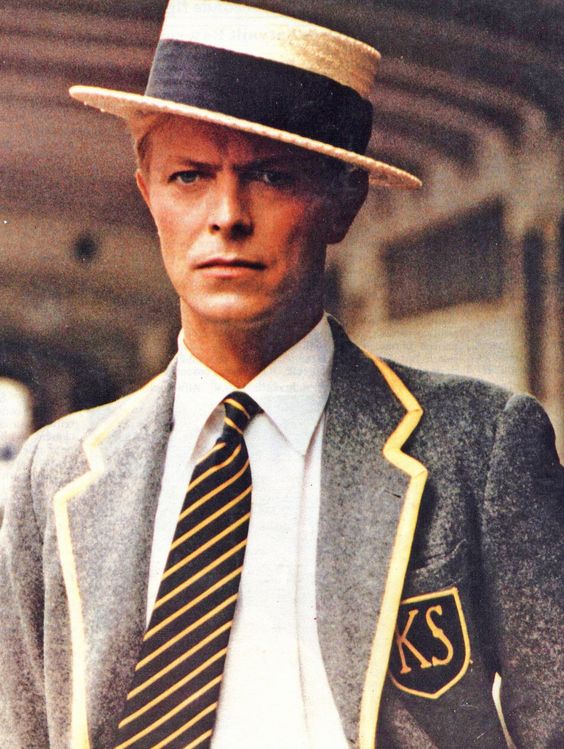
I’ve never been too keen on the boater. Yes, it’s made of straw and cool for summer and came out long before the soft roll up panama, but it’s like wearing an inedible cracker on your head.  Although now often viewed as a hat that is functionally terrible and aesthetically comical, the boater became the standard summer hat for millions of men around the world in the early 1900s.  It became a staple item in the respectable businessman’s hat wardrobe; in essence, it was, for a time, the summer version of the bowler.

Originally, in the mid 1800s, the boater (Also known as a “Sennet” or “Straw”) used to be a seafaring hat that was issued to and worn by British Royal Navy sailors during the summer months. These early boaters were softer than the version we see on the heads of Harold Lloyd and Fred Astaire in the 1920s and 30s because they were made to yield somewhat to the forces of wind and water encountered by a seaman on a long voyage. In its early days keeping the brim flat wasn’t much of a concern, so you’d see sailor after sailor sporting straw hats with warped brims.  Many Italian gondoliers still sport versions similar to the original ones worn by British sailors.

1f4e4a01aed2b9b6f01007be2a0dc6cb-1

As time went by, the boater went from being an item of military issue, to a fashionable and somewhat formal summer accessory. This is reflected in Manners for Men (1897), in which Mrs. C. E. Humphry informed her dapper readers that “For a morning walk in the Park in summer the straw hat, or low hat and tweed suit, are as correct as the black coat and silk hat.” Around the same time, English schools and colleges made the boater into a uniform requirement.

Clearly, the boater had successfully made the leap from respectable British military issue headgear to the smart but cumbersome lacquered and pressed straw halos you ended up seeing on American luminaries like David Wark Griffith and Calvin Coolidge, and on businessmen around the Western world.

Unsurprisingly, these hats never had the staying power of more comfortable summer hats. Their impractical and comical nature was played up by young students ‘skimming’ them under buses to pass the time (if they were lucky the passing bus would eat the hat); in the 1920s, boaters were turned into a faddish novelty, as college kids began pairing them with raccoon coats and pennants at pep rallies.  The farcical side (and thus the end of the more formal application) of this headwear was echoed in the appropriation of the boater by Vaudevillians and carnival barkers. Soon enough, you’d see foam versions worn with red, white, and blue ribbons issued to crowds at political rallies. The seriousness of the hat had clearly left.

If it had had more functionality than fashionability, perhaps the boater would have had as long a run as the Panama hats that you can still find at your local department store today.  Unlike its winter felt counterparts, the bowler, which originated as a hard gamekeeper’s hat that can be molded to a cranium to perfection with steam, or the soft fedora that’s an offshoot of the comfortable slouch hat worn in the field of battle, the boater requires that your head be the shape of the hat or you’re in for an ill fit. It is stiff and has no give. If you try to alter the shape to fit your head, you tend to warp the brim.

And yet, now I like it. I like it because nobody else is wearing it.  It stands out on the street corner. Although shunned by well heeled men decades ago and thus best worn with a slightly irreverent air, I find it adds an unexpected jauntiness to a well-tailored suit.  In 2016, it can give your look a panache that will certainly make you stand out amongst a sea of businessmen on a crowded summer street.

tumblr_m0a31oRqSU1r91qw7o1_500.jpg

Placement and proportions for the belt back suit

Matt Deckard Chevalier Simon James Cathcart SJC

This one comes as more of a demand from a few friends who needed some answers ASAP as they saw the Simon James Cathcart ‘Chevalier’ suit had an action back that was the same design I’d worked out a few years ago (the Indiana Jones Raiders of the Lost Ark back). The friends asked me what I saw wrong and SJC thanked me for explaining how to properly make the back of the ‘Chevalier’ suit functional and accurate to what was made in the 1930s. They are currently in the midst of making the new design for their clients.

To illustrate, below are the SJC jacket and an original vintage jacket.

The same idea,  yoke on the back, four pleats under the yoke and above the belt, with a center inverted box pleat.

The first one shown is the incorrect repro styling. (SJC Pre redesign design) The belt sits inches below the defined waistline set by the center button on the front of the jacket. The yoke at the shoulders is too long and the belt itself is much too narrow for the period, and for a proportional look. When worn it will cause the belt to rise to meet the waistline set by the center button on the front.

The second one shown is the correct (Vintage example) The belt sits directly below the center button at the front of the jacket. When worn, the belt will hold it’s position and the back will properly close.

Walnut+1930+suit+jacket+flat+back+full+1.jpgMatt Deckard Belt Back suit.jpg

Now to why the changes are being made, and the reasoning and logic to action back and belt back design. I’ve been asked about the SJC suit front as well and I think it’s a high stance two button converted to a 3 button, but that’s for another post.

Talking to a couple tailors I learned a lot more about armholes and body fit from when I began my quest to have a suit that fits well enough to make me feel as though I’m wearing pyjamas. I do like the roundtables in New York thanks to a friend of mine.  Now to the demanded info!

The half belted back and it’s placement.

When you put a belt on a jacket, the front and back of the belt is level. Usually it’s going to be directly at the wearers true waist. There have been dropped waist version in the 1910s and 1920s, and in the 1930s you’ll see the belts put on jacket more so at the true natural waist of the wearer.

Rather than showing exploded drawings of suit pieces, I’ll show you styles on people and hopefully make clear the logic behind the belting.

A belt all the way around the jacket clearly defines where the waist of the wearer is front and back. If there is a center button at the waist of the jacket, the button can often go through the button on a norfolk jacket that has a cloth belt, or like in the military stylings, the belt can be directly below. the center button but is still showcasing a uniform waistband around the jacket.

Matt Deckard Belt Back Norfolk.jpgJimmy Stuart Belt Back Matt Deckard.jpgPrince-Philip-in-Norfolk-Jacket-in-1952.jpgNorfolk_jacket_history_at_Keikari_dot_com.jpg

Matt Deckard 1920 Norfolk Belted suit.jpgNorfolk Suit Matt Deckard.jpg

There are examples of where the belt is actually dropped lower than the actual waist, but I’ve seen that it’s Proportional because the trouser have a lower waist and it’s the look of a trend of the time. — I’ll add photos of that shortly.

There are reasons to break the rule of where to put the belt when it’s going on the back of a jacket, but I’ve found if you do this, it’s for aesthetics rather than function.

The Jacket below has a center button defining the waist in the front but the rear belt is a bit lower than where the center button is placed. You can see the discrepancy in the waist placement by looking at the side pockets.

I’ve seen this mostly done on new models as I think the designers are separating the placement of the jacket’s front and back waistline, placing the belt nearer to where modern low waisted trousers have their waistline.

When paired with an action back, or even without, moving while wearing a jacket where the rear waistline is lower than the front waistline causes the belt to raise and sometimes hang higher or catch higher on the individual and bunch up the back of the jacket.

96ba5b9c368ced2506962d7a271a4074--tweed-suits-tweed-sport-coat.jpgecdf2f3c3f73a1e2c4f92a0a1a49ff69.jpg

There are also belted jackets where there is no center button placement, commonly these jackets are made to have both front buttons fastened and the belt in the rear is between the two buttons in the front.

When it came to me working to get proportions and placement correct, I went on a binge of not just tailoring books, but evidence on screen just to see action belt backs in action.

Below are several images from the 1934 Movie Transatlantic-Merry-Go-Round. Note again that the top seam of the belt is placed exactly where the button placement in the front lies. I’ve measured a few three button suits from the 1930s and when I wanted my own made, I went with that logic to keep my action backs functioning properly.


18671026_10154624764233811_8920505711979992029_n.jpg18581803_10154624764983811_4365359757100046979_n.jpg18664307_10154624768518811_6263274554890359530_n.jpg


Some Images from 1933 The Clark Gable movie, Dancing Lady. I love this suit! If you watch the movie, the belt is exaclty below where the center button placement of the front lies.

Matt Deckard Belt Back suit DL.jpgMatt Deckard Belt Back suit DL2.jpg

Matt Deckard Belt Back Jacket DL.jpg

Belted back Double Breasted jacket with four buttons. The two top buttons sit at the wearer’s natural waistline. The seam of the belt in the back, when measured from the bottom of the hem up, is at the same height as the top buttons stance.

22894399_10155086582388811_2639868622706074496_n.jpg

Clark Gable wearing a beautiful belt back confection!

9d3ffa879e6476d65fca15ae02a41aba.jpg

I went with a 2 inch belt and the yoke is not too large, but it was a science to get the proportions correct on that as well. Too wide and it’s very 1970s looking. Too narrow and it looks like a shoestring pasted to the back.

Action back in action. A yoke at the shoulders and and half belted back with an inverted box pleat.

542469_10150882754874718_1318328395_n-1.jpg181865_10150882753799718_357657424_n.jpg

I’m going to continue editing this with more visuals as I have a lot written that I don’t think will become clear without the right imagery.

Matt Deckard Beltback suit jacket guide.jpg